
Renovation Contingency - Part 2
Plan for the Worst and Hope for the Best
A renovation contingency is only useful if it is paired with execution.
Part 1 explained what contingency is and why avoiding it creates risk. Part 2 focuses on how to use contingency planning to protect your timeline, budget control, and finished quality once work begins.
Identifying these areas in advance helps sequence demolition and inspection in a way that surfaces critical issues early.
Approval and change process
Creating this process before work begins will save time and stress. If a team finds rot, mold, or failed framing and there is no agreed process, the schedule pauses. Establish the process up front:
- Documentation standard
- Scope and pricing format
- Approval authority
- Response-time expectation
This keeps corrective work moving without avoidable downtime.
Schedule and finish priorities
Owners should decide early how to prioritize schedule and finish outcomes. This will guide both you and the team through tough moments:
- Preserve finish scope even if schedule extends
- Preserve schedule by adjusting finish selections
Making this decision in advance avoids rushed tradeoffs later.
Pitfalls to avoid
Common contingency mistakes include:
- Assuming a newer home means low risk
- Treating unknown conditions as rare exceptions
- Spending contingency on upgrades too early
- Delaying corrective work to avoid short-term cost impact
- Rebuilding finishes before root-cause moisture issues are corrected
The most expensive approach is usually deferred reality. The most effective approach is prompt diagnosis and proper repair.
Execution priorities to include
Use contingency with a clear field strategy:
- Prioritize investigative demolition in likely risk areas first
- Document findings immediately with photos and scope notes
- Price corrective work transparently before restart
- Sequence work as repair first, finish second
- Rebuild with durable waterproofing, flashing, drainage, and ventilation details
This is how contingency protects project quality instead of only absorbing cost.
Planning guidance
Contingency planning is not expecting failure. It is accepting the realities of renovation and preparing to respond professionally. A practical rule of thumb: the more your project touches wet areas, exterior openings, or unknown prior workmanship, the more disciplined your contingency framework should be.
In real projects, control comes from early risk identification, fast documentation, and clear approvals. That is what keeps schedule impact manageable and protects trust between owner and builder.
Practical next step
Before final pricing and before demolition, create a one-page contingency execution
plan. The goal is simple: define risk areas, decision rules, and approval flow before hidden conditions are uncovered. This keeps your team from losing time in the field while everyone decides process under pressure.
At minimum, your plan should identify high-risk zones, establish documentation standards, confirm who can approve corrective scope, and define whether schedule or finish scope takes priority if tradeoffs are required. Once this is in place, your contingency becomes a management tool, not just a number in the budget.
To make implementation easier, use the checklist below as a starting point and adapt it to your area, project type, and contractor workflow.
When demolition opens concealed areas, unknown conditions become known conditions. The difference between a controlled project and a chaotic one is not whether issues are found. It is whether your team planned for those discoveries before they happened.
Four risk areas to settle before committing
- How to set a realistic contingency target based on renovation type and risk signals
- Where hidden moisture and structural failures are most likely to be found
- What approval and change process must be in place before unknowns are uncovered
- How schedule and finish priorities should be handled if corrective work is required
Setting realistic contingencies
To set a realistic contingency target, you need to understand what each risk area means in practice. Not all remodels carry the same unknowns. A dry-area cosmetic update has different risk than a bathroom remodel over finished space, basement work, or envelope-heavy projects involving windows and doors. Your contingency should match the actual risk profile, not a generic assumption.
What is hidden and where to find it
Most major surprises occur in predictable areas and are usually found right where you would expect:
- Shower and tub assemblies
- Toilet flange and floor transitions
- Window perimeters and flashing interfaces
- Roof-to-wall transitions
- Areas with prior remodel work of unknown quality
Renovation Contingency Prep Checklist (sample)
____ Scope and Risk Review completed before final pricing
- Wet-area risk zones identified (bathrooms, laundry, kitchen, basement)
- Exterior envelope risk zones identified (windows, doors, roof/wall transitions)
- Prior remodel areas identified for focused inspection
- Known leak, odor, staining, or moisture history documented
____ Contingency Budget Framework defined
- Contingency reserve established based on project risk profile
- Clear distinction between contingency funds and upgrade allowances
- Rules defined for when contingency funds can be released
- Owner decision authority confirmed for contingency use
____ Discovery and Documentation Process defined
- Field photo documentation standard established
- Unknown-condition reporting format established (issue, cause, scope impact, cost impact)
- Response-time expectation established for owner approvals
- Temporary protection steps defined if immediate safety or moisture mitigation is needed
____ Change and Approval Workflow confirmed
- Change-order format confirmed for hidden-condition corrective work
- Pricing method confirmed (time and materials or fixed corrective scope)
- Approval path confirmed (who approves and in what order)
- Communication cadence confirmed for active discoveries
____ Priority and Tradeoff Decisions made in advance
- If needed, schedule priority vs finish-scope priority established
- Non-negotiable repair standards confirmed (waterproofing, flashing, structural correction)
- Conditions requiring specialist review identified (mold, structural, mechanical, electrical hazards)
____ Pre-Demo Readiness confirmed
- Initial investigative demo zones identified in sequence
- Site protection and containment plan in place
- Repair-first sequencing aligned with trade schedule
- Lead-time items flagged if corrective work expands scope
Note: This is not intended to be a comprehensive checklist. Requirements and best practices vary by project conditions, municipality, and scope. Confirm project-specific requirements with your contractor, design team, and local jurisdiction.
Related Posts
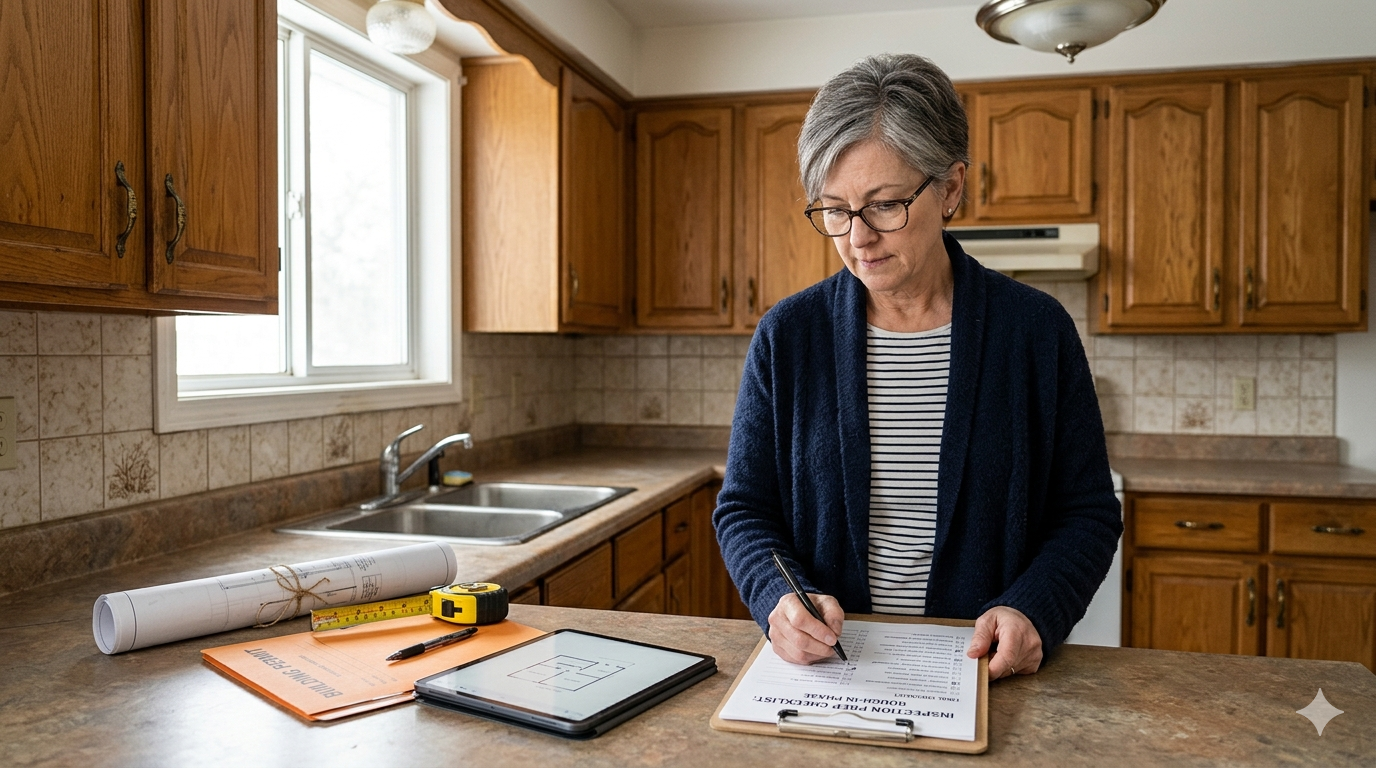
Inspection Prep Checklist
What to Finalize Before Rough-In Rough-in inspections can make or break your remodel timeline, so the prep work you do before walls close matters more than most homeowners expect. This
7 Kitchen Layout Decisions That Improve Daily Flow
A great kitchen layout saves steps, reduces stress, and makes ordinary moments easier. 7 Kitchen Layout Decisions That Improve Daily Flow Lorem ipsum dolor sit amet, consectetur adipiscing elit. Ut

How to Understand the Joy Score for Your Remodel Decisions
Joy comes from the choices you use every day, not the features you rarely touch. If you are looking for help with how to build a Joy Score for your